Odisha plans real-time pollution monitoring stations in mineral-rich areas

For monitoring of environmental quality in mineral-bearing areas, the Odisha government has drawn up a proposal for installing monitoring stations.

The State Pollution Control Board (SPCB) has identified eight mineral-rich districts for monitoring pollution by installing online continuous ambient air quality monitoring stations (CAAQMS) and continuous river water quality monitoring stations (CRWQMS) with real-time data transmission systems.

The identified districts are Angul, Sundargarh, Keonjhar, Rayagada, Jharsuguda, Koraput, Mayurbhanj and Jajpur.

In this regard, the board has submitted a proposal to the Odisha Mineral Bearing Area Development Corporation (OMBADC), a special purpose vehicle (SPV) formed by the state government following the Supreme Court order to carry out developmental activities in mineral-rich regions of the state.

While CAAQMS are proposed to be set up in six locations, CRWQMS will be installed in Rayagada and Jajpur.

Occupying an important position on the country’s map, the state’s rich mineral reserves constitute 28 per cent of India’s total deposits of iron ore, 24 per cent of its coal, 59 per cent of its bauxite and 98 per cent of its chromite reserves.

The state’s comparative advantage on this account has attracted the attention of many mining and metallurgical companies.

OMBADC’s objective is to improve social infrastructure such as provision of drinking water, sanitation, livelihood promotion, irrigation, skill development for alternative livelihood and supplementary income in the mineral-bearing areas. Besides, environmental upgradation, construction of roads, anganwadi centres, power supply infrastructure, health services, development of sports and other activities would also form part of the action plan. The task of the corporation is separate from the District Mineral Foundation concept introduced by the new Mines and Minerals Development and Regulation (MMDR) Act.

Courtesy: Business Standard
छत्तीसगढ़: लीज के नियम पूरे ना करने पर टाटा समूह से वापस ली जाएगी 1700 हेक्टेयर जमीन

छत्तीसगढ़ की नवनिर्वाचित कांग्रेस सरकार ने यहां टाटा समूह को स्टील प्लांट लगाने के लिए दी गई करीब 1700 हेक्टेयर जमीन को वापस लेने का निर्णय किया है। राज्य के बस्तर स्थित इस जमीन को टाटा समूह से लिए जाने के बाद इसे किसानों को वापस दिया जाएगा। मंगलवार को इस फैसले की जानकारी राज्य सरकार के मंत्री रवींद्र चौबे ने दी।
मंत्री रवींद्र चौबे ने मीडिया से बात करते हुए कहा कि पूर्व में टाटा समूह द्वारा किसानों से इस जमीन को स्टील प्लांट के लिए लिया गया था, लेकिन कंपनी ने अधिग्रहण के बाद लीज के लिए तय नियमों का पालन नहीं किया। इसे देखते हुए सीएम भूपेश बघेल ने अधिकारियों को जमीन वापसी संबंधित प्रस्ताव बनाने के निर्देश दिए थे। सीएम के निर्देश के बाद इस जमीन की वापसी की कार्रवाई शुरू की गई।

इससे पहले कांग्रेस अध्यक्ष राहुल गांधी ने भी बस्तर में अपनी रैली के दौरान यहां के किसानों को उनकी जमीन वापस दिलाने का वादा किया था। इसके अलावा पार्टी के घोषणा पत्र में भी यह ऐलान किया गया था कि छत्तीसगढ़ में अधिग्रहीत वह सभी जमीन जिस पर अधिग्रहण के पांच साल के भीतर कोई प्रॉजेक्ट स्थापित नहीं हुआ हो किसानों को वापस दिलाई जाएगी। बाद में सरकार बनने के बाद खुद सीएम भूपेश बघेल ने जमीन वापसी के लिए अधिकारियों को प्रस्ताव बनाने और इसे कैबिनेट की बैठक में प्रस्तुत करने के निर्देश दिए थे।

Courtesy: Nav Bharat Times

Mining firms stop school buses, 70 kids stuck at home

PANAJI: Around 70 children in Sonshi, and several others in the state’s mining belt, are unable to go to school as mining companies, after their operations came to a standstill following the Supreme Court order, stopped providing them transport.

It is the state government’s responsibility in these circumstances to immediately provide free transport to these schoolchildren as also water to these areas, Ashok Shrimali of the voluntary organisation mines, minerals and people said. Read more

TimesView Mining areas like Sonshi have always faced the brunt of government neglect, first when they were being smothered in pollution and now when their children have been deprived school bus service and are forced to stay home. The government provides buses to aided schools under the Bal Rath scheme, why does it not extend the scheme to government schools as economically underprivileged children are more likely to go to these schools.
“We held a daylong workshop today with mining affected people from across Goa and the main issues affecting them presently is no transport for their children to go to school and lack of water. Mining companies have stopped providing both as their operations have shut. They say they are now contributing towards the district mineral foundation (DMF) instead,” Ravindra Velip of mines, minerals and people said.

Velip said it is shameful that children are unable to go to school because of lack of transport. “It is the primary responsibility of the state government to provide these basic requirement and they should do so immediately. The state cannot wash its hands off the responsibility,” he added.

Shrimali said that the state government also urgently needs to carry out a study on the groundwater situation in the mining belt.

“Goa has a DMF of about Rs 186 crore, of which Rs 10 crore have been utilised so far. When we checked the ground reality, we were informed that due to mismanagement the Rs 10 crore which was spent has failed to benefit the affected community,” said Shirmali.

Courtesy: The Times of India

State govt mulls amendment to Concessions Act to resume mining

Panaji: Under pressure from mining dependants to take necessary action for resumption of mining, the government seems to be looking at amending the Goa, Daman and Diu Mining Concessions (abolition and declaration as mining leases) Act, 1987, sources in the ruling coalition said.

Sources said that this was one option as that there is no positive response from the Centre to the Goa government’s request to amend the Mines and Minerals (Development and Regulation) (MMDR) Act. Mining activities have stopped since March 16, 2018, following an order of the Supreme Court which held that the renewal of 88 mining leases was illegal.

Until December 20, BJP functionaries had been saying that the Centre is still considering an amendment to the MMDR Act during the ongoing winter session of the Parliament.

Minister of state for mines and coal, Haribhai Parthibhai Chaudhary, in response to a question tabled by South Goa MP Narendra Sawaikar on Wednesday, said “A proposal has been received from the Goa government to amend the MMDR Act, 1957, and the same is under examination in the ministry of mines.”

The minister, in his reply, also said that Section 8A (4) of MMDR Act, “provides that on expiry of the lease period, the lease shall be put up for auction” as per the procedure specified in the Act.

While Sawaikar may be hopeful, other BJP functionaries are of the view that the central government is not keen to amend the MMDR Act to benefit a small state like Goa for resumption of mining activities. Besides setting a new precedent, the view in the government is that the state request would go against the spirit of the act enacted by the Modi government in 2015 which was for auctioning of the natural resources, sources said.

Sources said the BJP central leadership in Delhi is examining the provisions of the Mining Concessions Act, 1987, for necessary amendment to get mining activities restarted in Goa.

A political observer said that after the results in the recently-held elections where BJP lost power in three states, the ruling party is under pressure not to ignore issues concerning the common man especially the ones which are related to employment.

On Sunday, president, Goa Minining People’s Front, Puti Gaonkar told TOI that they will meet on December 27 to take stock of the situation. Sources said that a team including some ministers will leave for Delhi later this week, most probably soon after Christmas.

Courtesy: The Times of India

70 children of Sonshi village in Goa struck in homes as mining dumps have made roads inaccessible

By Sayantani Sarkar

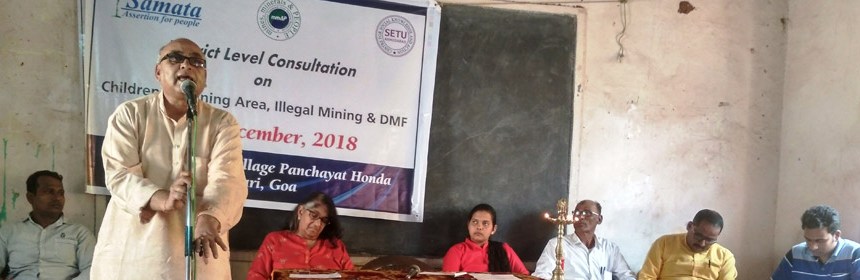
Samata and mines minerals and people (mm&P) organized a District Level Consultation on Children in Mining Area, Illegal Mining, District Mineral Fund (DMF) and Future Generation Fund in collaboration with SETU at Honda Panchayat, Sattari, Goa on 22nd December’ 2018.

The Consultation witnessed the presence of total 62 participants comprising of local government representatives like Panchayat Members, Sarpanch, community members from Sonshi, Soyle, Pissurle and Honda, members of Civil Society Organizations, and Women’ s Groups and Self-Help Groups (SHGs).

There were discussions on the overview of mining throughout the country, various stages of mining, illegal mining, Samata Judgement, situation of children in the mining areas and consequences on their education, health affected due to air and water pollution, malnutrition issues etc., and the need for lobbying National Level regarding Child Rights as they are being violated.

There were discussions on the situation of children in mining areas and it was said that “mining children are nobody’s children and are falling through the cracks” as they are mostly ignored by all the concerned child welfare departments, govt. authorities unaware of the mining children’s inclusion in the respective departments. There is a confusion and lack of clarity as in which department the children in the mining areas should be included and what basic facilities and amenities should be provided to them.

The community people of Sonshi shared that around 70 children of the village and the surrounding villages are struck in their homes and unable to go to school as mining companies after the mining operations came to a standstill following a Supreme Court order, stopped providing the children transport and the roads are inaccessible due to mining dumps placed near the villages. Secretary General of mm&P Ashok Shrimali said that “this is violation of the Right to Education Act and it is the state government’s responsibility to provide free transport for school.”

There were elaborative discussions on District Mineral Fund (DMF), its formation, implementation in all the states and lack of public awareness on the functioning of the DMF. It was found that people are unaware of the DMF which is meant to be utilized for the betterment of the mining affected communities and the funds collected are to be utilized to provide basic amenities like drinking water, sanitation, education, health and environmental conservation and preservation. It was also noticed that there was no community participation of the mining affected communities at the planning, formulation and implementation stage.

Shrimali stated that as per the information available, Goa has about Rs. 186 crore under DMF of which Rs. 10 crore has been utilized. However the ground reality is that due to mismanagement of funds, the amount spent has not benefitted the mining affected communities.

Executive Council Member of mm&P, Goa Ravindra Velip, said that no district has developed a comprehensive DMF plan to ensure need- based investments in mining affected areas. He alleged that while the role of gram sabhas and panchayats are sidelined, no beneficiaries are identified under the scheme.

Courtesy: Counterview

1 71 72 73 74 75 160