THE STATES
TEXT BY JOSH CHIN in Bellary
| The terrible consequences of uncontrolled iron ore mining in Bellary district prompt a demand for its curtailment. |
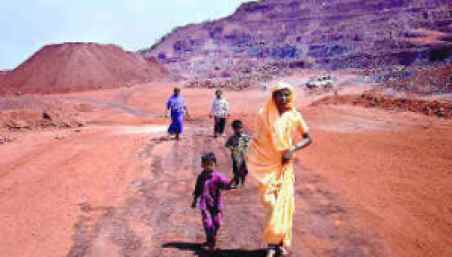
IN A MINING AREA in the Ramandurga hills south of Hospet.
LIFE may soon return to the dusty 19th century palace grounds of the Raja of Sandur in the Ramandurga hills near Hospet in Karnataka. A well-known private company is likely to buy the property and possibly restore the old buildings for offices. It will do this not for the site’s historical worth, but for the value of what juts out of the ground around it: a thick vein of high-quality iron ore.
“Wherever you stretch your eyes, you see ore,” says B. Chidamber, a retired engineer from the Karnataka Department of Mines and Geology (DMG). “It’s all ore. No dust at all. Just blast it, load it.”
For a region in the grip of a mining boom, history pales in importance before the future represented in its geological wealth. The Ramandurga hills, which form the northern tip of a 13,000-acre (5,200-hectare) triangle of land in Bellary district, is estimated to contain more than 1.2 billion tonnes of iron ore, the key ingredient in making steel. A sudden rise in the global price of Indian iron ore from $17 a tonne in 2000-01 to $55 a tonne in 2005-06 has transformed the area from an almost forgotten backwater into a mining juggernaut responsible for nearly 20 per cent of the country’s iron ore production. Once known for its sandalwood forests and abundant wildlife, the area now trembles day and night with the blasting of ore-laden hillsides and the rumble of lorries transporting rock from the mines to ports around India. According to informed sources in the Karnataka DMG, the region produced Rs.3,600 crores worth of iron ore in 2005. But frenzied and uncontrolled mining has had serious consequences, from the destruction of roads and illegal exploitation of forestlands to widespread pollution, rampant corruption, and exploitation of child labour. Its alarming impact has led labour organisers, environmentalists, political leaders and non-governmental organisation activists to demand that it be curtailed, or even stopped.
India opened its immense iron ore reserves to private exploitation in 1999. The voracious demand from steel-hungry China providing a seemingly endless market, India has quickly risen to become the world’s third largest exporter of iron ore, behind Australia and Brazil. The iron-ore rush in Bellary has brought little to one of Karnataka’s poorest districts. “This is public property, the wealth of the nation, but the mine owners can get it for themselves by paying a bribe to get a lease,” says Father Jose Pazheparambil, regional director of the NGO Don Bosco-Centre for Social Action in Hospet. “Meanwhile, not a rupee, not even a paisa, is spent for the development of the area.”
Illegal mining
As many as 64 iron ore mines operate in the Bellary mining triangle, according to the Karnataka DMG. Large mines such as those run by the state-owned National Mineral Development Corporation (NMDC) in Donimalai are exceptions. Private mining companies control almost 80 per cent of the land under lease for iron ore operations, with an average lease size of 200 hectares. The smallest of these private mines – four- and five-acre operations run by private landowners outside Hospet – do not even figure on the DMG’s lease list, because they are unregulated.
Estimated to number 12,000, these “float ore” mines – so called because workers dig by hand for small quantities of iron ore that “float” near the surface – are said to be the region’s biggest thieves of iron ore. Small farmers ruined by years of drought have cashed in on the boom by mining their agricultural farms themselves or contracting them out at Rs.25,000 to Rs.30,000 an acre (Rs.62,500 to Rs.75,000 a hectare). The float ore mines are the targets of the anti-mining lobby as they are responsible for some of the most egregious violations of labour and environmental laws, including child labour and failure to manage waste or soil erosion. Practically none has mining permits or pays taxes.
The legal status of these mines is unclear. According to Arvind Shrivastava, Bellary’s Deputy Commissioner, “the procedural requirements [for acquiring mining permits] are too much for small landholders”. Further, the 1999 mining policy exempts mines under 25 hectares from public review.
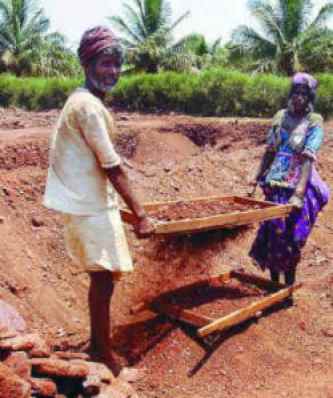
FILTERING IRON ORE fines in Hospet.
Some observers see the opposition to float-ore mining as a red herring, designed to draw attention away from the graver sins of larger mining operations. “Some people here don’t want small mines. If there’s only one big mine in an area, then that owner becomes a big man, while the little people become poorer and poorer,” says H.G. Rangan Goud, a Hospet native whose family has run a medium-sized mine in the area since 1949.
Less publicised illegalities are of even greater concern. One of these is the overloading of lorries that transport ore to ports and steel factories. According Shrivastava, roughly 7,500 of these massive vehicles rumble along Bellary’s roads at any given time, most of them carrying far more than the 15-tonne load allowed by law. Years of such traffic has turned the area’s unpaved roads into crenellated strips of dirt so broken that Bellary’s wealthier residents – mostly mine owners – are purchasing helicopters to bypass them. For the region’s other residents, and visitors to the nearby ruins of Hampi, mine traffic has become a miserable inconvenience. “It was just lorry after lorry after lorry,” Mark Walking, a Swiss tourist, said of his 300-kilometre journey by car from Goa to Hampi. “We were told the trip would take six and a half hours, but instead it took ten.”
Opposition politicians and the local media in Bellary accuse mine owners of encroaching on thousands of acres of forest land outside the limits of their own mines. Thirty mines were closed in late March for violating caps on iron ore production, just a fraction of the mines that engage in the practice, according to Gangaram Baderiya, Karnataka Commissioner of Mines. In a letter to Chief Minister H.D. Kumaraswamy recently, Minister of Forests C. Chennigappa, accused MSPL, one of the largest mining companies in Hospet, of illegally mining 157 acres beyond its lease, according to press reports. He alleged that illegal mining as a whole had cost the state Rs.25,000 crores in lost revenues.
Top officials of the Karnataka DMG disagree over whether encroachment even exists. Baderiya identifies it as one of biggest problems facing the department, though he declines to estimate the extent. K.N. Rajanna, Additional Director for Minerals, disagrees. “Illegal mining occurs only on private land,” he says. “We’ve not noticed any encroachment [on forest land].”
Rejecting the allegations against his company, Rahul Baldota, Executive Director of MSPL, says, “Ninety-nine per cent [of us] are doing legal mining. Maybe a handful are doing some illegal stuff, but the rest is politics.”
HIDDEN COSTS
The damage to both people and the environment is perhaps the most troubling of the mining boom’s side effects. A government-commissioned investigation by the National Environmental Engineering Institute (NEERI) in 2003 found that the levels of heavy metals in the water and dust-related particulate matter in the air exceeded national health standards. It also discovered significant loss of forests. According to the report, the region’s wildlife, which once included robust populations of sloth bears, leopards, monitor lizards and white storks – all threatened or endangered species – “is observed to be very poor”.
B.T. Venkatesh, a lawyer and a native of Hospet, recalls his childhood hunting foxes and deer in Sandur’s famous sandalwood forests. “No more,” he says. “You used to be able to walk amongst fruit trees. Gone. All because of the mines.”
The most pervasive environmental threat comes from mining dust, a suffocating rust-coloured cloud of debris that coats everything in and around the mining triangle. According to the NEERI report, this dust is responsible for “public health problems, reduction of agricultural productivity and has its impact on wildlife”. Dr. B. Manjunath, a local physician, says the dust has produced a “significant rise” in bronchitis and other respiratory infections and is also responsible for a staggering incidence of eye problems, chiefly conjunctivitis. “If you live in Hopset and travel by bicycle or motorbike, you will get it,” he says. Dust also contributes to the appalling labour conditions endured by tens of thousands of informal workers, many of them children.
According to some government and steel industry representatives, the export of unprocessed iron ore has resulted in the starvation of India’s domestic steel industry. They argue that if exported as fully finished steel products, these exports would enhance domestic revenue and employment. India is China’s second largest supplier of iron ore and exported 68.5 million tonnes to that country in 2005-06. Many of those shipments contained the famous high-quality ore (65%+ Fe content) from Bellary. As the country looks to increase annual domestic steel production from the current 38 million tonnes to 100 million tonnes by 2020, many worry that the best iron ore will have already been spent.
Unscrupulous trade
With the cost of production at Rs.100 a tonne, the region’s mine owners made a total profit estimated at Rs.3,100 crores last year. Yet government royalties have remained shockingly low, rising from Rs.24 to just Rs.27 a tonne in October 2004, well after the China boom had begun. According to the DMG, Karnataka collected Rs.80 crores in royalties in 2004-05, less than 2 per cent of what the ore was worth in the market.
Meanwhile, windfall profits have transformed Hospet’s economy. According to V.G. Khanolkar, Assistant General Manager of the State Bank of India’s Hospet branch, the tiny branch has seen a staggering 2,000 per cent increase in withdrawals since the boom started, from Rs.3 crores every six months to nearly Rs.40 crores a week. Real estate prices have gone up by 400 per cent in the past three years. The region’s wealthy have developed a reputation for being the first in India to purchase the latest luxury cars. According to local press reports, Bellary will soon have Asia’s highest per capita concentration of private helicopters.
Anti-mining activists often speak of a “mining mafia” comprising mine owners, politicians and law enforcement officials, united in a desire to keeping the profits flowing. While they have so far failed to tie politicians to mining, they insist that such a collusion best explains why, for example, so many officials in the government continue to deny the existence of encroachment, and why environmental and labour regulations have gone largely un-enforced.
State level-officials this writer spoke to say the boom simply took them by surprise. The Deputy Commissioner points to low staff and funding levels in the various department offices and to China’s purchases of huge quantities of iron ore fines – coin-sized particles of iron ore previously regarded as waste – which has speeded up the mining process.
Uncertain Future
The excesses of the region’s mining boom are ultimately the result of the government’s push for liberalisation of the sector. Iron ore exploitation was opened to the private sector, with oversight handed to State governments, in a series of decisions at the national level in the 1990s. Karnataka’s new mining policy, published in 2000, trumpets export-oriented development and promotes steps to “smoothen the prevailing office procedures” for the granting of mine leases.
Both the State and Central governments have announced strategies to rein in the iron ore frenzy. The Central government is likely to release a new national mining policy that is expected to curb exports of high-quality ores. The Karnataka Commissioner of Mines said that he had asked the Central government to replace the current fixed-rate royalty system with one that would take market prices into account. Investigation teams are in the process of being formed, he said, to detect mining violations in Bellary. Violators will face “stringent consequences”, including cancellation of leases and criminal prosecution, according to him.
Anti-mining activists are sceptical of these assurances. If anything, mining seems poised to expand further. Negotiations to set the long-term price for iron ore with China – a move expected to cement exports in place – are reportedly nearing conclusion. Meanwhile, according to the Karnataka DMG, 10,000 more hectares have been recently opened to mining to meet a backlog of at least 5,000 lease applications. An Australian bid for mining is likely to be approved by the Central government soon, opening the sector to foreign companies as well.
Few in the official establishment talk about the NMDC. It owns the largest mining operation in Bellary-Hospet, is India’s largest exporter of iron ore, and has helped local steel-makers by selling them high-quality iron ore at below-market rates. It is also the only mining company in the region that observes environmental and labour laws. “They don’t use child labour and they obey the environmental rules, because they have to,” says Dr. Bhagyalakshmi, Hospet representative of Mines, Minerals & People, a national mining watchdog NGO.
Back at the Raja of Sandur’s old palace, Chidamber, the retired engineer, does not bother to wonder what will happen if India goes back to mining on the state-run model. He is resigned to the forces of the market. When this writer asked if he would not be sad to see the historic site dug up, he looked around at the buildings and shrugged. “Ore is worth more, no?”

