Govt of India push for ‘commercially important’ invasive timber for afforestation to damage ecology, groundwater

The recently-released draft National Forest Policy (NFP), says a representation before the Ministry of Environment, Forests and Climate Change (MoEFCC), would adversely affect scheduled tribes, 90% of whom live in forest areas and intractable terrains, by turning them into migrant construction labourers by displacing them for the exploitation of minerals and other development projects. Read more

Courtesy: Counterview

State Level Consultation – Mandi, Himachal Pradesh

In the State Level Consultation at Mandi, Himachal Pradesh there were discussions on the overview of mining throughout the country, various stages of mining, illegal mining, Samata Judgement, situation of children in the mining areas and consequences on their education, health due to air and water pollution, malnutrition issues etc., and the need for lobbying at National Level regarding Child Rights as they are being violated. There were discussions on the situation of children in mining areas as it has three aspects to it. Firstly, children (Child Labour) engaged in the hazardous industry. Secondly, those children who are not working in the mines but are living there and thirdly parents of the children who work in the mines. In all these aspects, the rights of the child get undermined.

In Himachal Pradesh, there were also discussions on Mining Rules & Law Amendments, DMF Structure, Set up & present status, Cooperative mining – shareholding for the tribals, Silicosis, lack of implementation of FRA, Labour Act, Displacement, Communities command over natural resources, MGNREGA, Hydropower energy, RTE. With regard to illegal mining cases throughout the country, Himachal Pradesh stands 7th.

State Level Consultation – Haldwani, Uttarakhand

In the State Level Consultation at Uttarakhand there were discussions on the overview of mining throughout the country, various stages of mining, illegal mining, Samata Judgement, situation of children in the mining areas and consequences on their education, health due to air and water pollution, malnutrition issues etc., and the need for lobbying at National Level regarding Child Rights as they are being violated. There were discussions on the situation of children in mining areas as it has three aspects to it. Firstly, children (Child Labour) engaged in the hazardous industry. Secondly, those children who are not working in the mines but are living there and thirdly parents of the children who work in the mines. In all these aspects, the rights of the child get undermined.

In Uttarakhand, participants shared issues on underground water mining, water gravity, migration, literacy & population, mining struggles, Pradhan Mantri Khan Khanij Yojna etc. There were also discussions on Mining Rules & Law Amendments, DMF Structure, Set up & present status, Cooperative mining – shareholding for the tribals, Future Generation Fund (model of Goa), Women & Mining etc.

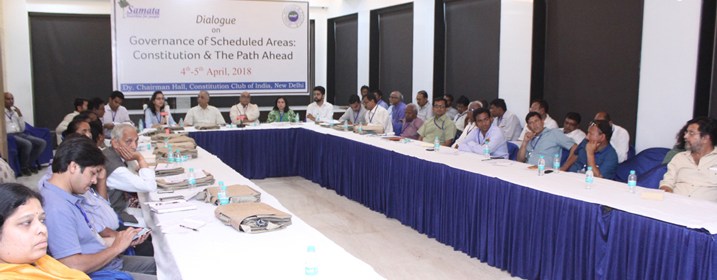
Dialogue on Governance of Scheduled Area

Dialogue on Governance In Scheduled Areas: Constitution and Path Ahead- Samata, along with the Mines, Minerals and People (mm&P) had organized a two-day deliberative sessions on governance and plight of the Adivasis inhabiting the scheduled areas of India. The rationale for the dialogue stems from the recent legislations and judgments which have had an adverse effect on the Adivasis, their livelihood, culture, health and environment. The Conference brought together legislators, activists, legal luminaries, academicians, researchers, journalists and the voices from the ground that can lead to a more meaningful and collaborative process between various stakeholders culminating in a more inclusive development policy recommendations. The conference had been an attempt to addresses mainly three questions:

First, how has the courts ensured access to justice by reformulating traditional principles of “Rights”? Second, how have the legislators and executives at the centre and the state level responded to the newer interpretations of the court? And finally, how after 25 years of reforms the fate of the Adivasis has not shown any discernible change in any parameters of development index? What are we missing? Is it not the time to think differently! It is truism to iterate here that data regarding tribals, their dispossession, displacement, health hazards, educational outcomes, even official ones, are at best sketchy and unreliable.

1 121 122 123 124 125 160